We built a game from an AI-generated video, put it in front of people, and watched. They loved it. They also ran straight past nearly everything we had made. This is what that taught us, what we changed, and how we check each new version of the game before anyone plays it.
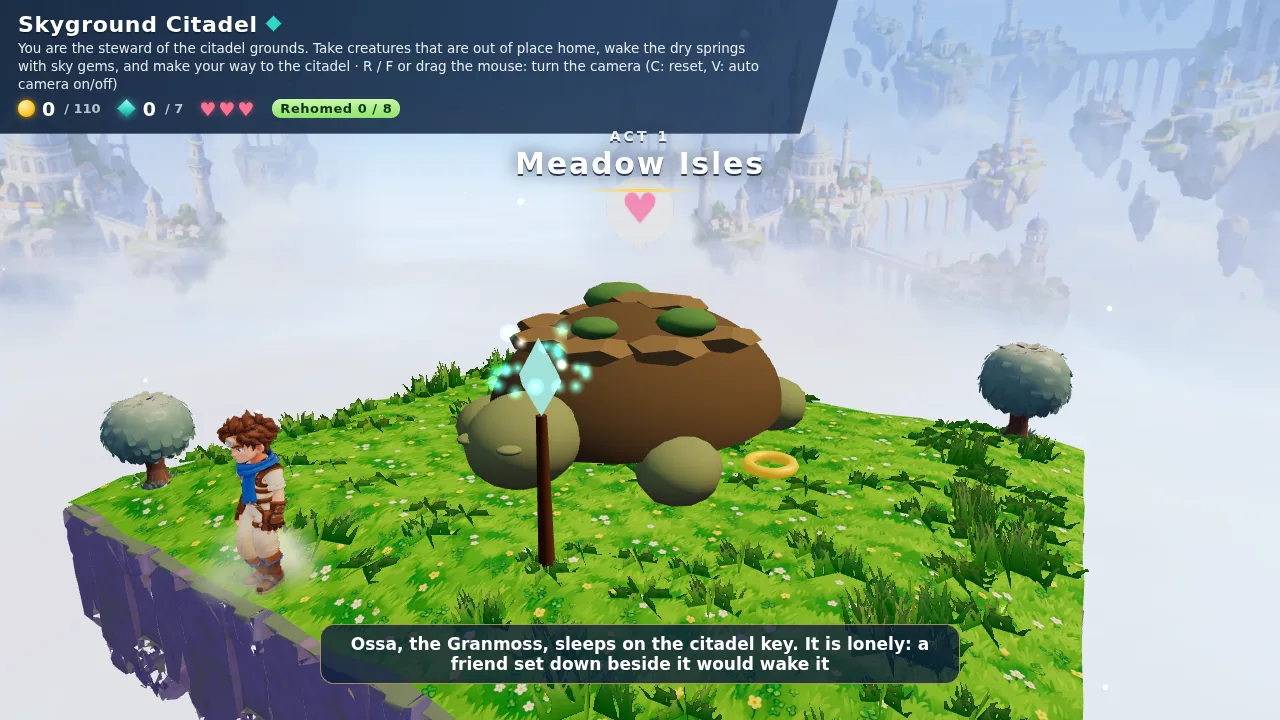
About the screenshots. Every image here is a screenshot of the game as built on 22 November 2026, and you can play in your browser.
The game is Skyground Citadel, a small 3D platformer for the browser that began as one AI-generated video of a boy running across floating islands. We told the first part of that story in How We Turned an AI Video Into a Playable Game Level. This post is about what happened when real people played the result.
Kids and adults played it. It held their attention. And most of them tried to speedrun it. They sprinted for the gate, ignored the animals, ignored the water, and some of them told us, in different words, that they could not see why any of it was there.
They were right, and the cause was our design, not their attention.
What Did We See Watching People Play?
The notes from the watching sessions were short and specific:
- Most players raced to the end. A few went into every corner, but the racers were the majority.
- The final guardian was confusing. To get the key you had to land on the largest creature, and nothing told you so.
- The automatic camera swung round when people did not expect it.
- Nobody saw a reason to wake the dry streams, even though waking one gives water creatures a home.
- Some players would rather fall than be caught by the vines that pull you back up, because the climb felt slow.
- A sharp question from the person watching: why does Kai start far from the citadel, and why are coins and gems lying around if he is the groundskeeper?
We had built a world full of life and then paid players to ignore it.
Every item on that list had the same root. Nothing in the game depended on the creatures or the water. A stopwatch in the corner rewarded speed, and a star on the finish card rewarded few falls.
Why Did the Story Need to Explain the Odd Facts?
The coins question mattered most. A game can get away with odd facts until someone asks about them, and then the whole thing looks arbitrary. So we wrote one premise that answers all of it.
Kai is the citadel's groundskeeper. A season ago the grounds went untended, which we call the Lapse: springs dried, creatures wandered from their homes, the harvest went unpicked. Kai was away for it, and he comes back up through the one way-crystal that still answers. The coins and gems are the unpicked harvest, which is why they are lying about. And the citadel sealed itself while he was gone, because a steward absent for a season counts as a failed steward. That is why he is locked out.
The next question follows at once: where is the key? We wanted the answer to make the creatures matter.
What Is a Creature With Needs, Not a Gate?
The old key sat under a guardian you landed on. The new one is held by Ossa, the Granmoss, the largest creature on the grounds, too big to move and unbothered by anything Kai can do to it. It sleeps on the key, on an island far from the gate.
Ossa wants something. We built that the way we built the smaller creatures, which already have a hunger and an energy that rise and fall and decide what they do. Ossa has four needs, loneliness, hunger, boredom and covetousness, each a number between zero and one. Whichever is strongest is its desire.
Four desires, one creature
| What it wants | How you meet it | |
|---|---|---|
| Loneliness | Company | Set a creature it likes down beside it |
| Hunger | Food | Bring five pieces of ripe fruit from the early islands |
| Boredom | A story | Read it the book that lies under the wooden arch |
| Covetousness | A hoard | Press thirty coins into its shell |
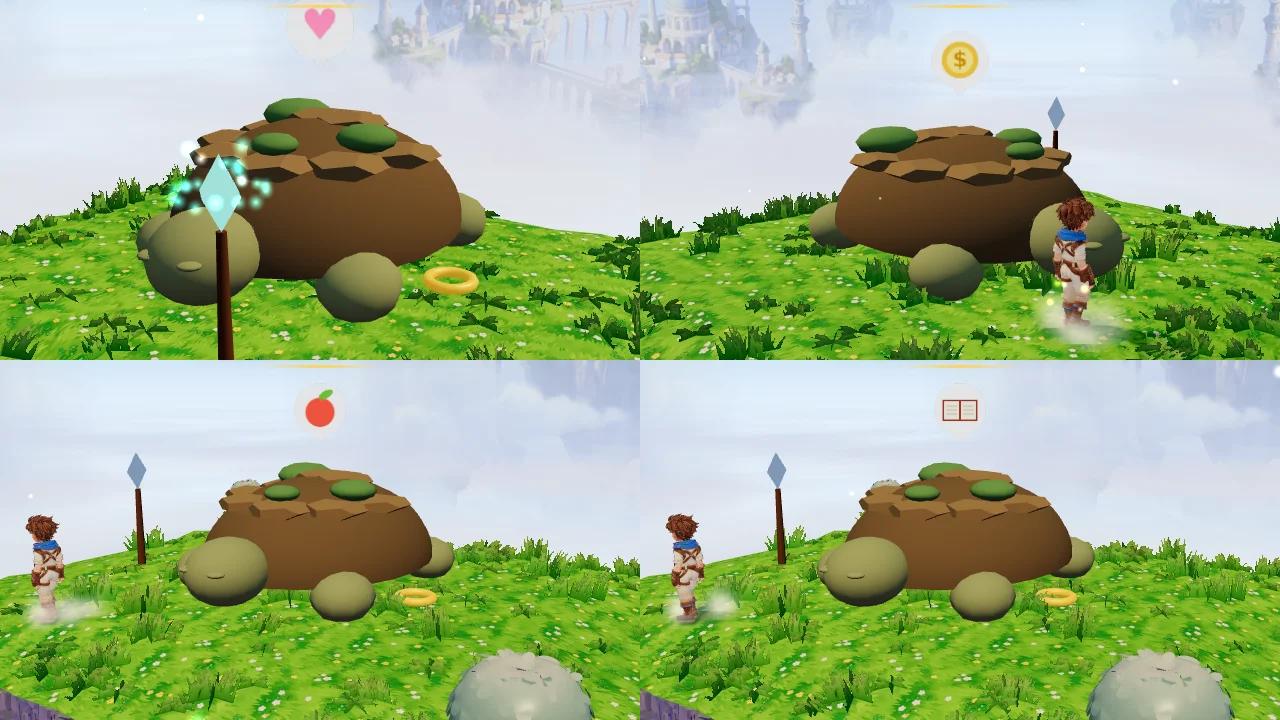
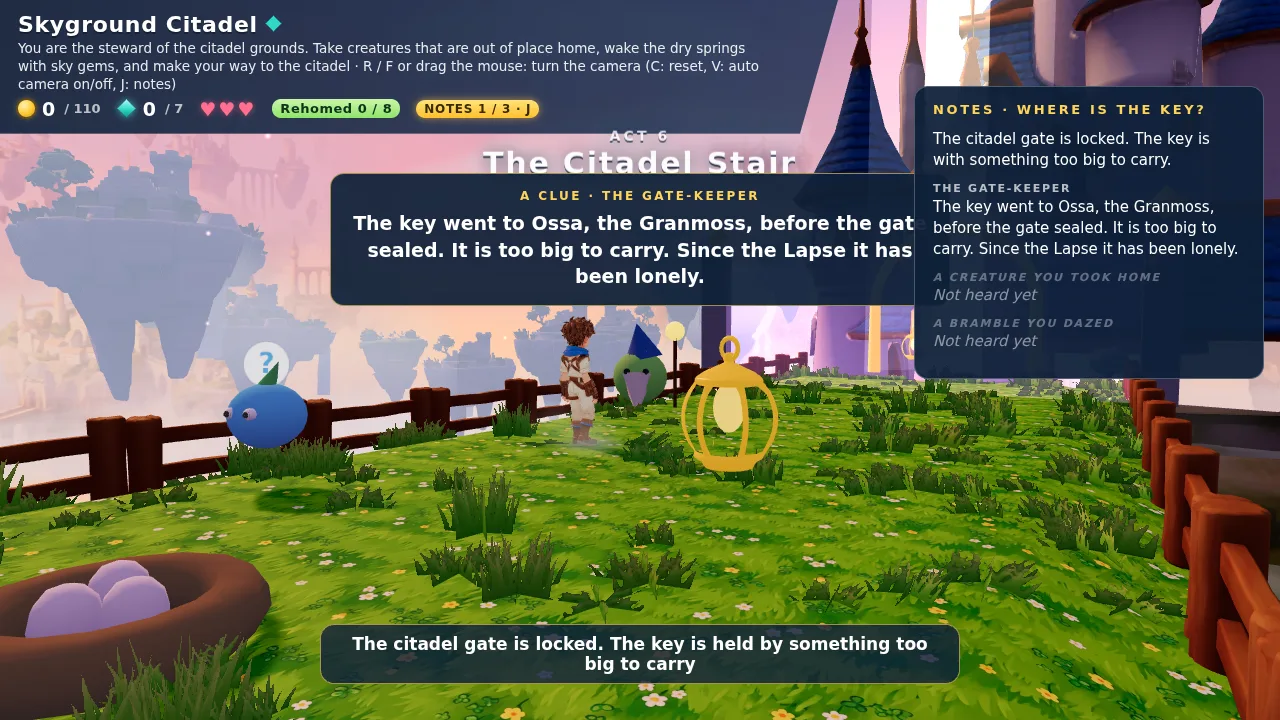
The needs are set from a seed, and a new page load is a new seed. So every run, Ossa is on one of three islands and wants one of four things. A player who rushes to the gate finds it locked, learns the key is held by something too big to carry, and has to go and find out why. The ones who spent time with the creatures already know where to start.
Ossa is also solid now. In the first build you could run straight through it, and a playtester did.
Why Three Clues, and None of Them the Answer?
Finding one creature on a map is only a challenge if the map gives you something to follow, and only a game if it does not give you everything. We settled on three clues from three sources, each telling only part of the story:
- The gate-keeper, a small bearded lantern-bearer at the gate, says who holds the key and what Ossa has wanted since the Lapse. It names no place.
- A creature you took home thanks you and says where not to look.
- A bramble you daze with the gust mutters a landmark in the old steward's words, such as where his stone still listens, not a direction.
Two clues narrow the search and three place it. A notes panel on the J key keeps them, because the player has to go back. We tested the balance across 300 seeds: the gate-keeper never names a place, the creature never points at the true island, and the bramble gives a landmark and never a direction.
One rule came from a playtester pressing buttons. The creature clue first fired whenever you picked up a creature and put it down again, even one that already lived there. Now it only counts if the creature was out of place and ends up where it belongs.
How Do We Check a New Version Before Anyone Plays It?
This is the part we would repeat on any project. A scripted player plays the game from the same rules the real one runs on, and it has to finish the whole journey on every combination of island and desire: three islands times four desires. It is handed what Ossa asks for, since it does not gather fruit, and it must get the key and reach the gate. A test suite of 174 checks sits around it.
We also record it. At each checking point we render the scripted player's whole playthrough at low resolution and file the video in a Numonic collection, titled with the build, the run number and what it shows. The result is footage of every stage, ready for a blog post or a promotional video, with no one having to remember to capture it. The rendering is in software, so motion and timing are exact but frame rate is not what a real graphics card would give. We say so in each file.
What Did the Checks Miss?
The checks are good at rules and poor at feeling, so the best finds came from people.
A playtester fed Ossa eight pieces of fruit, and reported seeing no sign of receiving a key. We could not reproduce a missing key: the key was given, the badge and the message showed. But the feedback was easy to miss, so it got louder. The key now lifts from under Ossa and flies to the player in a glowing arc, a message says Ossa has given you the citadel key and where to take it, and the key badge in the corner pulses.
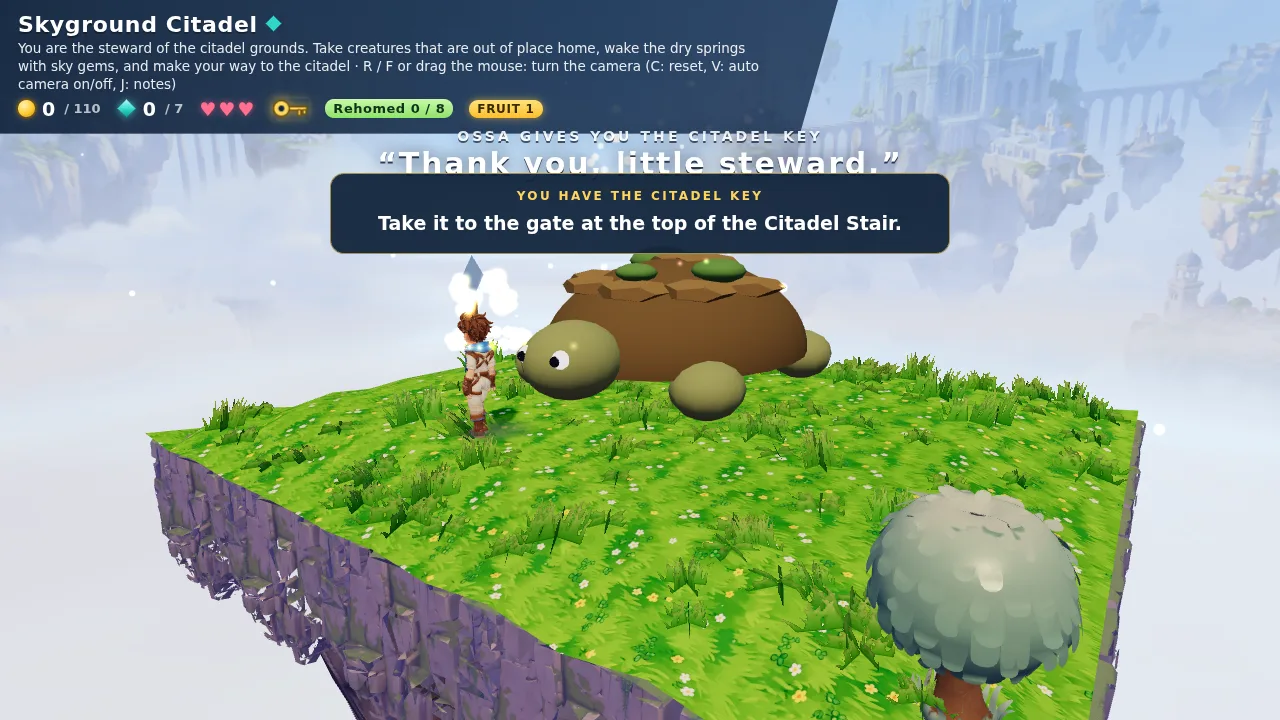
We also changed the badge from a labelled pill to a small key icon, and a press near Ossa that is too far away now says "come closer" instead of doing nothing.
Running the new code in a real browser caught something no rule test could have: a variable in the new message handler shadowed a helper, which would have thrown an error at exactly the moment Ossa was pleased. And one of our own site checks went stale: it expected the scripted player to run straight down the course in ten seconds, but the player now fetches a creature for Ossa first. The check had to learn the game had changed.
Shipping had its own near-miss. A deploy command, run from a shell already pointed at a different project, was one missing folder away from targeting the wrong production site. It failed before uploading anything. We now deploy from a clean copy linked to the right project, and a check that the link names that project comes before anything goes out.
What Did We Leave Out, and What Do We Not Know Yet?
We did not add a glow on the skyline to show where Ossa is. It would have given the island away.
And there are things we cannot say yet. Frame rate on weaker machines is untested; on one machine, an earlier build averaged about 54 frames a second. Nobody has played the clue trail cold, without us telling them how it works. The first week of players in the Discord channel is the real test of whether three clues is the right number.
Key Takeaways
- Players ran past what we built because nothing depended on it. A stopwatch paid for speed, so speed is what we got.
- A story that explains the odd facts does design work. The unpicked harvest and the sealed citadel answered the questions players asked.
- Give a hidden thing needs, not just a location. A creature with hunger or boredom turns a hunt into a reason to play.
- Clues work when each one is partial and the notes keep them. We tested that they never give the answer away.
- Record the scripted run at every checking point. You end up with footage of every stage for free.
- Checks catch rules; people catch feeling. Make the feedback for key moments hard to miss.